
Wednesday, April 4, 2012
Elizabeth Catlett: a treasured friend, a remarkable artist
As I was weepily reminiscing with someone about Elizabeth Catlett, she asked me when did I meet Elizabeth Catlett and I told her that I first met her on the pages of James Porter's 1943 book Modern Negro Art. My parents gave me this groundbreaking book when I was 8 years old and had announced my intention to be a sculptor when I grew up. They wanted me to know that there were indeed Black women who were sculptors so that I would know my aspiration was realizable. I thumbed through my first art book with intense interest and found myself transfixed on Elizabeth's marble "Negro Mother and Child". Since I had recently been introduced to carving by my instructor at Fleischer Memorial Art School, I immediately grativated to this magnificent work. My young mind didn't appreciate all of the technical aspects of this piece but I can remember thinking what emotion the artist captured both in the pose and the faces of her subjects.
Two years later, my parents gifted me with Cedric Dover's American Negro Art and once again I found Elizabeth's work mesmerizing. This new "Mother and Child" had a different, albeit equally powerful affect on me. The mother had her feet firmly planted on the earth, almost in defiance, with the child nestled in her lap but appearing just at firmly self-aware as its mother. Whereas the "Negro Mother and Child" baby hid itself in its mother's torso, "Mother and Child"'s baby faces us with only its head tilted inwards. Both figures seemed very strong to my ten year-old mind, a quality I rather liked.
It helped immensely that Elizabeth Catlett's politics matched that of my parents. Like her, they were "blacklisted", making their lives a living hell for the better part of the late forties into the mid-fifties. As I think back on the intentionality with which my parents introduced us to artists, I now am clear that they chose Elizabeth Catlett over, say, a Selma Burke, because they agreed with her political stances as much as they did her aesthetic choices. They were making it clear to me from the start that one could be political and still be a damn good artist! The art in our house reflected the conviction my parents had regarding us kids seeing ourselves reflected on our walls so the offset prints of W.E.B. Dubois or the beautifully rendered elder Black woman by Charles White made us know that Black people were worthy subjects for works of art, as worthy as the white subjects we encountered on our frequent visits to the Philadelphia Art Museum.
Fast forward to 1971 and my tenure in graduate school at University of Wisconsin Madison. As horrific as that experience was (no Black art faculty, just about as many students, and no love, trust me, no love!) I had several wonderful things happen in that cold, cold town. The first was that I elected to take a course in African American Art History from an instructor who wasn't much older than me. That began a lifelong friendship with the now fully tenured professor, Dr. Freida High Tesfagiorgious (she was just Freida High then!) I took this course because I simply wanted to have an opportunity to converse about artists I knew with other people who were interested. I needed to know that I wasn't crazy for wanting to seek inspiration for my work from within my own cultural experience and I thought a class on the history of my predeceesors would affirm my ideas. It turned out that Freida needed me in the class as much as I needed the class since she was newly aware of this history and had not done that much in-depth research on the topic. In a sense, she was learning as the class learned! But it was a perfect class for me because we always had discussions rather than lectures, and lord knows I love to discuss! As a part of the class requirement, we had to attend the National Conference of Artists which proved to be the second wonderful thing that happened to me while a graduate student for it was at the DC conference that I met my idol, later to become my mentor, Elizabeth Catlett.
I can remember like it was yesterday the moment I found out that Elizabeth was going to attend this conference and how excited I was at the prospect of seeing her. She was to receive an award as one of the elders who helped shape the organization. The banquet planned for the award ceremony was much too expensive for any of us students so we knew we'd have to be satisfied with possibly catching a glimpse of the notables going into the banquet hall. Never one for star-gazing, I decided I'd just sit outside with some of the other "rebel artists" and debate the merits of awards and the capitalist structure that mandated favoring one artist over another. So there I was engrossed in conversation with who, I don't even remember, when I heard someone say "so what's going on with you young people?" I looked up and there she was! Elizabeth Catlett had decided it was more important for her to spend some of her limited time stateside checking out the next generation of Black artists. She, like us, didn't place a lot of stock in awards, especially those swapped between friends. I am pretty sure I let out a small gasp when I realized I was sitting next to my sho nuff idol but she didn't seem to notice. I asked her if she'd tell us about her work and I swear to God she said "forget about my work, tell me about yours". So I did. We discussed my struggle to maintain my identity in a school that had no interest in it. She reassured me that I'd make it through grad school with my identity intact as long as I didn't allow it to be compromised. Her warning stuck with me and indeed I did get through the experience with somce scars but a stronger sense of commitment to my aesthetic.
As time passed, I had numerous visits with my idol and indeed we became friends. My visits to her residences, both in Mexico and New York were always productive. Her advice held me in good stead as a Black woman navigating the typically hostile art world sea, and her common sense suggestions about
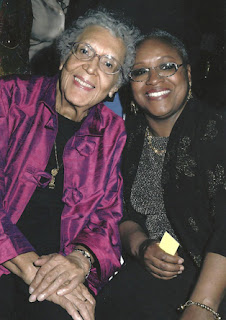 being an artist mother were as helpful as her art critiques. Elizabeth Catlett was one of the most practical women I've ever met and therefore having a conversation with her never left you confused. Whether I was asking how I could possibly be a mother and an artist only to have her respond "what are you crazy? Of course you can. You just have to put the work on hold for a little while!" or wondering about marrying (her answer: marry a feminist and you'll be ok!) Elizabeth always shot straight with me.
I will sorely miss this incredibly dynamic woman whose life epitomized the ideal Black woman artist for me. I shudder to think what my life would be like had I not had her in it, helping me understand how possible it is to be an artist/activist without either role overshadowing the other. Elizabeth Catlett-Mora changed lives; I know she changed mine.
being an artist mother were as helpful as her art critiques. Elizabeth Catlett was one of the most practical women I've ever met and therefore having a conversation with her never left you confused. Whether I was asking how I could possibly be a mother and an artist only to have her respond "what are you crazy? Of course you can. You just have to put the work on hold for a little while!" or wondering about marrying (her answer: marry a feminist and you'll be ok!) Elizabeth always shot straight with me.
I will sorely miss this incredibly dynamic woman whose life epitomized the ideal Black woman artist for me. I shudder to think what my life would be like had I not had her in it, helping me understand how possible it is to be an artist/activist without either role overshadowing the other. Elizabeth Catlett-Mora changed lives; I know she changed mine.


Monday, June 29, 2009
The Great Jazz Great Debate: Really???
After reading yet another article recently on the "glory years of jazz" and the usual lamentation on the demise of this art form, I couldn't help but wonder if anyone ever worried about the demise of European classical music. So much is made of what jazz is or isn't and how terrible it is that straight-ahead jazz is no longer at the helm of the jazz vanguard, when to me, the real discussion should center on why America cannot accept classical jazz as its only contribution to the classical music genre.
I grew up in a house where jazz was king. I heard the music from the time I was a little girl until I moved away from home to go to college. I had an uncle, and have a brother and a sister, all of who were/are jazz performers. I am a devotee of the music and support it to the best of my ability in the cultural center I manage. So I feel qualified to present what I'm calling an informed opinion about this on-going debate. Jazz in America, has never been elevated to the status of European classical music despite its acceptance by Europeans as such. As is true in so many other instances of Black life, when the measure of worthiness is based on acceptance by others, the true value of the contributions of that life is never fully appreciated by its originators. Jazz is played by all kinds of people who bring all kinds of interpretation to the music. But like, European classical music, it has its classical form from which all other offshoots are derived. When we talk about traditional, straight-ahead jazz, we should actually be calling it classical jazz.
Every civilization has its classical period in the arts and America didn't begin to develop hers until the late 19th, early 20th century when artists in all disciplines finally began to reference America rather than Europe for inspiration and aesthetic development. So in the scheme of world culture, the American arts are infants but no less influential than the arts of classical Europe. You just need to travel the world and see the impact jazz has on world music to know that our major contribution to that world, besides popular music, is jazz. The respect the music receives throughout the world is the reason so many American jazz musicians spend their careers abroad. If the same respect were afforded the music in its birthplace, perhaps we wouldn't need to reminisce about the "good ole days of jazz" because that music would be included in the music curricula of all American music education programs alongside that of Europe.
So much of this debate centers on the importance of particular jazz composers like Coltrane, Miles or Monk and their innovations and how we don't see their genius replicated today. Well that is why they are geniuses! I don't hear anyone complaining about how we don't see any Mozarts or Beethovens anymore as if this kind of prodigy comes around with any frequency. Its that double standard at play; when it's jazz we're talking about, we refuse to place the music in the same arena as European classical music, worthy of the same level of scholarship. It is precisely because jazz is relegated to a lesser status that we constantly engage in the kinds of squabbles contemporary jazz musicians do about what is or is not legitimate jazz expression. Is Ornette Coleman's music any less significant than Duke Ellington's simply because it strays from the classical format? Is freestyle jazz less worthy for the same reason? None of this would even be debatable if jazz were afforded its proper place in the music arena. The fact that American children never even hear the name John Coltrane or Thelonius Monk in the course of their music education unless they take a Jazz studies course underscores my point. The sad reality is that like everything else related to the Black Experience in America, jazz is a constant reminder of the second class citizenship held by African Americans. No matter how esteemed the music is outside our country, it still remains a stepchild at home, despite the efforts of many to change that position. This debate is more about this dichotomy than anything else. I only hope I live to see the day when jazz will become a staple in the musical diet of all Americans.
I grew up in a house where jazz was king. I heard the music from the time I was a little girl until I moved away from home to go to college. I had an uncle, and have a brother and a sister, all of who were/are jazz performers. I am a devotee of the music and support it to the best of my ability in the cultural center I manage. So I feel qualified to present what I'm calling an informed opinion about this on-going debate. Jazz in America, has never been elevated to the status of European classical music despite its acceptance by Europeans as such. As is true in so many other instances of Black life, when the measure of worthiness is based on acceptance by others, the true value of the contributions of that life is never fully appreciated by its originators. Jazz is played by all kinds of people who bring all kinds of interpretation to the music. But like, European classical music, it has its classical form from which all other offshoots are derived. When we talk about traditional, straight-ahead jazz, we should actually be calling it classical jazz.
Every civilization has its classical period in the arts and America didn't begin to develop hers until the late 19th, early 20th century when artists in all disciplines finally began to reference America rather than Europe for inspiration and aesthetic development. So in the scheme of world culture, the American arts are infants but no less influential than the arts of classical Europe. You just need to travel the world and see the impact jazz has on world music to know that our major contribution to that world, besides popular music, is jazz. The respect the music receives throughout the world is the reason so many American jazz musicians spend their careers abroad. If the same respect were afforded the music in its birthplace, perhaps we wouldn't need to reminisce about the "good ole days of jazz" because that music would be included in the music curricula of all American music education programs alongside that of Europe.
So much of this debate centers on the importance of particular jazz composers like Coltrane, Miles or Monk and their innovations and how we don't see their genius replicated today. Well that is why they are geniuses! I don't hear anyone complaining about how we don't see any Mozarts or Beethovens anymore as if this kind of prodigy comes around with any frequency. Its that double standard at play; when it's jazz we're talking about, we refuse to place the music in the same arena as European classical music, worthy of the same level of scholarship. It is precisely because jazz is relegated to a lesser status that we constantly engage in the kinds of squabbles contemporary jazz musicians do about what is or is not legitimate jazz expression. Is Ornette Coleman's music any less significant than Duke Ellington's simply because it strays from the classical format? Is freestyle jazz less worthy for the same reason? None of this would even be debatable if jazz were afforded its proper place in the music arena. The fact that American children never even hear the name John Coltrane or Thelonius Monk in the course of their music education unless they take a Jazz studies course underscores my point. The sad reality is that like everything else related to the Black Experience in America, jazz is a constant reminder of the second class citizenship held by African Americans. No matter how esteemed the music is outside our country, it still remains a stepchild at home, despite the efforts of many to change that position. This debate is more about this dichotomy than anything else. I only hope I live to see the day when jazz will become a staple in the musical diet of all Americans.
Saturday, May 16, 2009
Missing August & Lloyd...
I recently went to see one of my favorite August Wilson plays, "Joe Turner's Come & Gone" in NYC because it was getting "rave" reviews by the NY critics and I hadn't seen it staged for a while. My sister, brother-in-law and I were hyped to see it and wondered how we'd like it compared to the original production we all had seen.
Anyone who is in love with August Wilson's work as much as I am knows that the direction of his work is critical because the work is so nuanced, things can go real haywire if that piece of the presentation equation is not just right. Well it was not "just right" for this production! In fact it was "just wrong"! I kept expecting August to come down and say "stop this madness!"
OK, in the interest of full disclosure I should say that what this rant is really about is the notion of white directors directing Black plays. I know there is a lot of controversy about this topic and I certainly believe there may be some validity to the idea that a great director can direct any play. But this play, as do all of Wilson's works, demands a sensitivity to black life that I am not convinced can be felt by anyone other than black people (and frankly, not all black people for that matter). The main problem with this production was a lack of subtlety and the ignoring of that wonderfully nuanced manner of writing so beloved in Wilson's work. Everyone operated at full throttle, almost over the top at all times, making me feel like I wanted to turn down the volume five notches! The " I'm a tortured black man" quivering voice delivery of Herald Loomis (you've all heard it in the 70s black exploitation films of old!) made me want to run up on stage and slap him into realness.
Maybe I've been spoiled and maybe it's unfair to compare productions that were directed by Lloyd Richards with the blessing of August Wilson to this one but I can't help but to wonder what both would say about this staging of "Joe Turner...". August was a firm believer in the idea that black theater needed to be executed by black people. He caught a lot of flack for this stance but never backed down from it. I understand his point and appreciate it given the fact that we as a people are still trying to get our authentic voice heard in all areas of the arts but particularly in the dramatic arts. We still see way too many stereotypical depictions of our life in America whenever the telling is left to others. Sure on occasion, someone non-black comes close but I can't think of a single white writer or director who's gotten it right on. Like many, I do believe that our stories resonate universally but that does not translate into them being exactly like anyone else's story. The universality comes in the sub-text: ideas of family torn apart; love gone wrong; dreams shattered; etc. But, as the cliche goes, "the devil is in the details" and the details of all Wilson plays are what cannot be compromised as they provide the authenticity of the black experience; at least this can be said about the black experience prior to the 21st century dawning. August understood this better than anyone which is why his portfolio of work tells our story so completely, so complexly, so compellingly. It's a difficult story to sum up in an evening's sitting and it's a story I have not experienced in a Wilson staging without ending it with tears, that is until I saw this latest staging. This one ended with me mad as hell! I felt cheated; like I had been hoodwinked. My sister and brother-in-law felt the same way and we couldn't help comparing it to our past experiences. I guess we'll have to get a few more years past knowing what Black Life in America was like and in many places continues to be before I can accept a reinterpretation of August Wilson's work. Right now I think it's too fresh on my mind despite the "post-racial" dynamic we're seeing in American political and social discourse. August Wilson and Lloyd Richards were clear on how our story needed to be framed and presented and I appreciate their steadfast insistence that it be told by us albeit for everyone to experience.
Sunday, January 18, 2009
The Trip; the Impact
Throughout the next few months I plan to post my observations, revelations, hallucinations, and every other thing that changed my personal outlook as a result of my first trip to Africa by way of Senegal. The first is posted and rightfully reflects on Goree Island, the start of our journey as a people to Africa-America.
That this trip was made on the dawning of a new era in American history, an era that will see this great, conflicted nation about to inaugurate a man of African descent as its leader, is an irony not lost on me. It is on the minds of all who accompanied me, from the youngest to the oldest. That it was made during the holiest of times in America, when the most important Judeo-Christian religious ceremonies are celebrated, also seems fitting since most assuredly we all expected to have a spiritual experience that mere words could never articulate.
So bear with me as I bare my feelings about my journey. I promise not to tell you every single detail but I want you to understand how I am processing all that I experienced and for me that will come best as writing and ultimately art. More to come...
That this trip was made on the dawning of a new era in American history, an era that will see this great, conflicted nation about to inaugurate a man of African descent as its leader, is an irony not lost on me. It is on the minds of all who accompanied me, from the youngest to the oldest. That it was made during the holiest of times in America, when the most important Judeo-Christian religious ceremonies are celebrated, also seems fitting since most assuredly we all expected to have a spiritual experience that mere words could never articulate.
So bear with me as I bare my feelings about my journey. I promise not to tell you every single detail but I want you to understand how I am processing all that I experienced and for me that will come best as writing and ultimately art. More to come...
Ile de Goree- A Painful Observation
The dirt from Goree will not leave my feet. I scrub and scrub, followed by a Wet Wipe bath and no luck...
It's as if the ancestors want to stay with me forever and make me take their spirits off that wretched island.
The walls of the slave house didn't really speak to me but the air did; the atmosphere did; the sea did.
My thoughts kept fixed on the millions dwelling beneath me as I made my way across the bay to the island aboard a modern day ferry boat, wondering how it must have felt to be on one of those precursors, those slave ships, those wooden graves, leaving my continent bound for who knows, bound...
I watch with a heaviness as the island begins to make itself seen, the prison/garrison barely visible, and I feel the weight of history beginning to pull me down, so standing is not an option.
Then as the boat begins to turn into the port I make myself stand to witness the returning to Goree that hundreds and thousands of African Americans make every year, a returning that bears witness to the horrific beginning of a new African people, the lost ones, the soulless ones, the African Americans.
I fill up; I wonder how I will see myself in the slave house.
Finally, I am in it; I am in the now sanitized torture chambers made palatable by the Senegalese government so that commerce can continue, this time trading in the history of the enslaved rather than the enslaved individuals whose blood, excrement, urine, tears, tears and more tears soaked and stained the stone/dirt floors.
"Enfants" labels a doorway.
The babies/children's room, a room that should never have meaning beyond "playroom" but that has sustained a horrible definition change in this pink prison of death and dying.
"Enfants", I weep...
"Jeune Filles", I look at that doorway and think of the three teenage girls who accompany me on my journey and realize that they and their peers would inhabit this chamber, sustaining rape and degradation daily, sometimes multiple times daily, bearing the bastard children of the enslaver and his minions.
I have no strength when I leave the hallways of that pink atrocity, making my way to the Door of No Return but I must see it, experience being framed in it the way my ancestors must have been as they were pushed out of it towards the waiting wooden death vessels.
The sea still laps at the coast line looking placid and gentle.
But I know just beneath my gaze lies the whole of my soul drowned in this beautiful body Atlantic.
The double assault of European tourists and African hustlers sickens me as I leave the pink disaster zone.
I cannot breathe; my head seems to be closing itself to reason. I weep again while comforting my crying friend who cannot, will not, forget her ancestors' pain.
Ile de Goree I have returned but I cannot sat I will again.
The soul has been filled with ancestral memory and there is no room for anything else to occupy my leaden heart.
It's as if the ancestors want to stay with me forever and make me take their spirits off that wretched island.
The walls of the slave house didn't really speak to me but the air did; the atmosphere did; the sea did.
My thoughts kept fixed on the millions dwelling beneath me as I made my way across the bay to the island aboard a modern day ferry boat, wondering how it must have felt to be on one of those precursors, those slave ships, those wooden graves, leaving my continent bound for who knows, bound...
I watch with a heaviness as the island begins to make itself seen, the prison/garrison barely visible, and I feel the weight of history beginning to pull me down, so standing is not an option.
Then as the boat begins to turn into the port I make myself stand to witness the returning to Goree that hundreds and thousands of African Americans make every year, a returning that bears witness to the horrific beginning of a new African people, the lost ones, the soulless ones, the African Americans.
I fill up; I wonder how I will see myself in the slave house.
Finally, I am in it; I am in the now sanitized torture chambers made palatable by the Senegalese government so that commerce can continue, this time trading in the history of the enslaved rather than the enslaved individuals whose blood, excrement, urine, tears, tears and more tears soaked and stained the stone/dirt floors.
"Enfants" labels a doorway.
The babies/children's room, a room that should never have meaning beyond "playroom" but that has sustained a horrible definition change in this pink prison of death and dying.
"Enfants", I weep...
"Jeune Filles", I look at that doorway and think of the three teenage girls who accompany me on my journey and realize that they and their peers would inhabit this chamber, sustaining rape and degradation daily, sometimes multiple times daily, bearing the bastard children of the enslaver and his minions.
I have no strength when I leave the hallways of that pink atrocity, making my way to the Door of No Return but I must see it, experience being framed in it the way my ancestors must have been as they were pushed out of it towards the waiting wooden death vessels.
The sea still laps at the coast line looking placid and gentle.
But I know just beneath my gaze lies the whole of my soul drowned in this beautiful body Atlantic.
The double assault of European tourists and African hustlers sickens me as I leave the pink disaster zone.
I cannot breathe; my head seems to be closing itself to reason. I weep again while comforting my crying friend who cannot, will not, forget her ancestors' pain.
Ile de Goree I have returned but I cannot sat I will again.
The soul has been filled with ancestral memory and there is no room for anything else to occupy my leaden heart.
12/21/2008
Wednesday, October 1, 2008
CREATIVITY & BLACK CHILDREN
Well it's been a minute since my last post and much has transpired. The South Dallas Cultural Center is extremely active and the community is solidly in here! We completed our summer arts institute which always has me thinking about children and their innate sense of creativity. Since we typically work with South Dallas children exclusively, I can also say that the aftermath leaves me thinking about the impact of arts and cultural programming on children from low-income households.
Every year we host approximately 70 children and youth in our Summer Arts At the Center Program (SAAC). The children are not pre-selected, that is to say they are not "creamed" from the art stars in the community. Instead, we open our program to all children and it's first come, first served,making the playing field as even as possible. Over the years we do, however, tend to get families returning which makes for a wonderful opportunity for sustained learning. I am never disappointed in the outcome of the program no matter how hairy the start-up! In fact I almost always find myself in tears at the end when the children showcase their achievements for their parents and the community. The sight of them exploding with creativity, singing, reciting their poetry, acting, drumming and dancing is often overwhelming, particularly given how many of them have never done these things before. This is why I am so adamant about offering the highest quality program possible to our children. They deserve it and they make me proud every summer with their enthusiastic embrace of their culture. Since the methodology employed is quite intentional, the SAAC staff can see direct results of their efforts correlated with measurable outcomes. So its not just a feel good experience for us but a true measurably successful educational one.
So it is no surprise that I am livid when the first thing to go are the arts programs when public school systems are stretched for money. They are still seen as frills even after years of study indicate their direct impact on academic achievement and self-esteem. We know that children who have a daily diet of arts perform more successfully in their other subjects. They have a greater sense of discipline and understand the notion of team work more so than their peers who do not have the arts included in a meaningful way in the curriculum. Children from low income households, in my 28+ years of experience, tend to be even more creative and resourceful in their creativity than middle-class and upper class children. I suspect this has a lot to do with the fact that they have to be creative in order to survive their circumstances; they are always thinking of new ways to do things, ways that don't require purchasing expensive supplies or materials. They are the original recycled art makers! I taught a sculpture class this summer to 6-8 years old students. Sculpture is usually a difficult subject to teach to little kids primarily because all the focus in public schools (if there is any art at all, that is!) is on 2D work. Conceptualizing in 3D is a challenge for most children. Yet I witnessed some amazing works come out of the creative minds of my students, most of who were working with materials totally foreign to them. They watched me do a demonstration and then enthusiastically dove into their work, never worrying about whether it was "right" or not, a worry I usually encounter when I work with non-low income students. The assignment that involved recycled materials produced even better results. My observation is that the less traditional the material provided for artmaking, the more sophisticated the artistic outcome.
Which leads me to my primary reason for this blog: advocating for keeping the arts alive and well in our community, specifically in those areas of our community where they are woefully lacking. No matter what our school systems decide to do about arts education, we as thinking activist artists must keep it alive for our children! We must realize that the challenge ahead to keep African Americans moving in a positive direction goes far beyond just achieving a better economic status. We must be ever vigilant about making artistic & cultural literacy a priority for our children since we know that this sures up their intellectual foundation and thereby gives them a leg up in our society. It is no secret that the best private schools for the wealthy always include the arts and cultural study of European societies as an essential ingredient in their educational curriculum. They understand that the arts provide one of the best ways to document the history of a people which is why training ones young in the cultural & artistic traditions of your society ensures its perpetuity. What we know of ancient civilizations we know largely from the arts left behind upon their demise. It is why the first thing to be attacked when an aggressor is conquering a country is the cultural community. Wipe out art and artists and you wipe out the spiritual glue of any society. It is why the culture of the African was attacked, trivialized and destroyed when The Transatlantic Slave Trade was instituted. The enslavers knew that a people secure in their culture and allowed to express themselves creatively can never be spiritually or intellectually enslaved.
So let us not be fooled by the argument that the arts are a "frill" and can be sacrificed in hard times. The arts for our children are often their savior, particularly in a system that is designed for their failure. Let's make sure that we keep art in the lives of African American children at whatever personal cost to us as a community because I know that a child grounded in his or her culture, a child who has the wherewithal to create on a consistent and high quality basis, is a child who grows up to be an asset to the community, not a predator on that community. Invest in the creative and cultural education of Black children and you invest in the productive future of the African American community.
Every year we host approximately 70 children and youth in our Summer Arts At the Center Program (SAAC). The children are not pre-selected, that is to say they are not "creamed" from the art stars in the community. Instead, we open our program to all children and it's first come, first served,making the playing field as even as possible. Over the years we do, however, tend to get families returning which makes for a wonderful opportunity for sustained learning. I am never disappointed in the outcome of the program no matter how hairy the start-up! In fact I almost always find myself in tears at the end when the children showcase their achievements for their parents and the community. The sight of them exploding with creativity, singing, reciting their poetry, acting, drumming and dancing is often overwhelming, particularly given how many of them have never done these things before. This is why I am so adamant about offering the highest quality program possible to our children. They deserve it and they make me proud every summer with their enthusiastic embrace of their culture. Since the methodology employed is quite intentional, the SAAC staff can see direct results of their efforts correlated with measurable outcomes. So its not just a feel good experience for us but a true measurably successful educational one.
So it is no surprise that I am livid when the first thing to go are the arts programs when public school systems are stretched for money. They are still seen as frills even after years of study indicate their direct impact on academic achievement and self-esteem. We know that children who have a daily diet of arts perform more successfully in their other subjects. They have a greater sense of discipline and understand the notion of team work more so than their peers who do not have the arts included in a meaningful way in the curriculum. Children from low income households, in my 28+ years of experience, tend to be even more creative and resourceful in their creativity than middle-class and upper class children. I suspect this has a lot to do with the fact that they have to be creative in order to survive their circumstances; they are always thinking of new ways to do things, ways that don't require purchasing expensive supplies or materials. They are the original recycled art makers! I taught a sculpture class this summer to 6-8 years old students. Sculpture is usually a difficult subject to teach to little kids primarily because all the focus in public schools (if there is any art at all, that is!) is on 2D work. Conceptualizing in 3D is a challenge for most children. Yet I witnessed some amazing works come out of the creative minds of my students, most of who were working with materials totally foreign to them. They watched me do a demonstration and then enthusiastically dove into their work, never worrying about whether it was "right" or not, a worry I usually encounter when I work with non-low income students. The assignment that involved recycled materials produced even better results. My observation is that the less traditional the material provided for artmaking, the more sophisticated the artistic outcome.
Which leads me to my primary reason for this blog: advocating for keeping the arts alive and well in our community, specifically in those areas of our community where they are woefully lacking. No matter what our school systems decide to do about arts education, we as thinking activist artists must keep it alive for our children! We must realize that the challenge ahead to keep African Americans moving in a positive direction goes far beyond just achieving a better economic status. We must be ever vigilant about making artistic & cultural literacy a priority for our children since we know that this sures up their intellectual foundation and thereby gives them a leg up in our society. It is no secret that the best private schools for the wealthy always include the arts and cultural study of European societies as an essential ingredient in their educational curriculum. They understand that the arts provide one of the best ways to document the history of a people which is why training ones young in the cultural & artistic traditions of your society ensures its perpetuity. What we know of ancient civilizations we know largely from the arts left behind upon their demise. It is why the first thing to be attacked when an aggressor is conquering a country is the cultural community. Wipe out art and artists and you wipe out the spiritual glue of any society. It is why the culture of the African was attacked, trivialized and destroyed when The Transatlantic Slave Trade was instituted. The enslavers knew that a people secure in their culture and allowed to express themselves creatively can never be spiritually or intellectually enslaved.
So let us not be fooled by the argument that the arts are a "frill" and can be sacrificed in hard times. The arts for our children are often their savior, particularly in a system that is designed for their failure. Let's make sure that we keep art in the lives of African American children at whatever personal cost to us as a community because I know that a child grounded in his or her culture, a child who has the wherewithal to create on a consistent and high quality basis, is a child who grows up to be an asset to the community, not a predator on that community. Invest in the creative and cultural education of Black children and you invest in the productive future of the African American community.
Saturday, May 3, 2008
African Americans and Abstraction: Thinking of Puryear
Recently I had the pleasure of seeing the Martin Puryear restropective and hear him speak about this awesome collection of sculptures. The Modern Museum of Fort Worth has the good fortune to own a Puryear and so it was appropriate that it would host the Puryear retrospective. As one of the premiere contemporary art museums in the Southwest, MMFW created a beautiful and sensitive installation of the works, with gallery after gallery devoted to the
incomparable sculptures crafted so elegantly by Puryear.
Having taught his work for many years in my Art History and Art Appreciation classes, I was astonished at the power imbued in them when viewed as an entire body. It reinforced my original belief that sculpture should never be taught using books! Sure, one can argue that no art should, but sculpture in particular really suffers an identity crisis when viewed in two-dimension. The sheer scale of Puryear's work leaves one breathless not to mention the subtle textural surfaces most possess. I found myself spending an inordinate amount of time engrossed in these textures trying to determine how each was created. In a word, the work is exquisite!
So needless to say I was thrilled at the prospect of hearing the artist discuss his process and inspiration and was not disappointed by his offerings. Puryear is crystal clear in his delivery on his work ethic, aesthetic concerns, and creative process. He explained his switch from realism to abstraction in a way that even a novice art viewer could understand and appreciate, particularly given how so many artists are wont to engage in artspeak, rather than straight talk. As I looked around the room at the eager listeners, I was struck by how few African Americans were in the audience. I was a little downhearted by this typical situation and was reminded of an acquaintance who recently declared with assuredness that anyone could do abstract art and how he thought it was all hype and required no talent. I tried, in vain, to explain the difference between a successful abstract work and one that didn't succeed but I realized halfway through my discourse that he was never going to get it because he had no foundation from which to discuss the topic. I started thinking about how ironic it is that a people who's entire art aesthetic was derived from the originators of abstraction i.e. Africans, are so removed from it today. I thought about how Europeans appropriated that aesthetic, created numerous art movements based on it and ultimately made African Americans believe it had no meaning for us. I looked at the beauty and subtly of Martin Puryear's sublime forms and listened to him speak about the metaphorical meanings each piece embodied and couldn't help but feel distressed that we as a people have lost the ability to read any imagery except that which is realistic. We devalue all that does not speak to us on the most literal or decorative level, reducing any abstracted imagery or forms to meaningless hype.
Like so many areas of culture, we need to reclaim that which we originated and study our art history starting with its root aesthetic, African artforms. Although Martin Puryear openly
acknowledges the influence of many different cultures on his work, he spoke quite directly about the way in which African art, architecture, and life, during his tenure in West Africa spurred his
need to explore abstraction after years of working in a realist manner. Puryear, like so many European artists, began to push his creativity beyond his prior limits, looking at the essence of forms, eliminating the superfluous and only retaining the most essential elements. Like his ancestral forefathers, Puryear embraced the natural materials he used with respect, allowing them to help determine the final product he creates. He also began to visually talk about life in more subtle ways, kind of like talking in parables rather than just blurting things out. In essence, Puryear became a visual poet rather than a visual non-fiction writer, giving us the edited and reductive conversation about what is rather than filling our eyes with too many words! I think that is why his work has always moved me so completely. I cannot ever remember thinking when I looked at a Puryear piece "boy, I wish he'd left that element off" or "why did he use that material for this piece?". Everything I've seen that he created seems just right and never overstated or overworked; which underscores why it pains me that more African Americans in
Dallas/Fort Worth are not enjoying this magnificent exhibition. I guess we have a ways to go when it comes to enjoying visual art. Or maybe I am just being overly pessimistic because this is the medium I work in. If I'm real honest about it, I guess I have to acknowledge that classical jazz musicians have the same complaint, as do authors like Toni Morrison and Ishmael Reed! Be that as it may, I encourage anyone that has the opportunity to see Martin Puryear's exhibition,
even if it requires traveling to do so.
incomparable sculptures crafted so elegantly by Puryear.
Having taught his work for many years in my Art History and Art Appreciation classes, I was astonished at the power imbued in them when viewed as an entire body. It reinforced my original belief that sculpture should never be taught using books! Sure, one can argue that no art should, but sculpture in particular really suffers an identity crisis when viewed in two-dimension. The sheer scale of Puryear's work leaves one breathless not to mention the subtle textural surfaces most possess. I found myself spending an inordinate amount of time engrossed in these textures trying to determine how each was created. In a word, the work is exquisite!
So needless to say I was thrilled at the prospect of hearing the artist discuss his process and inspiration and was not disappointed by his offerings. Puryear is crystal clear in his delivery on his work ethic, aesthetic concerns, and creative process. He explained his switch from realism to abstraction in a way that even a novice art viewer could understand and appreciate, particularly given how so many artists are wont to engage in artspeak, rather than straight talk. As I looked around the room at the eager listeners, I was struck by how few African Americans were in the audience. I was a little downhearted by this typical situation and was reminded of an acquaintance who recently declared with assuredness that anyone could do abstract art and how he thought it was all hype and required no talent. I tried, in vain, to explain the difference between a successful abstract work and one that didn't succeed but I realized halfway through my discourse that he was never going to get it because he had no foundation from which to discuss the topic. I started thinking about how ironic it is that a people who's entire art aesthetic was derived from the originators of abstraction i.e. Africans, are so removed from it today. I thought about how Europeans appropriated that aesthetic, created numerous art movements based on it and ultimately made African Americans believe it had no meaning for us. I looked at the beauty and subtly of Martin Puryear's sublime forms and listened to him speak about the metaphorical meanings each piece embodied and couldn't help but feel distressed that we as a people have lost the ability to read any imagery except that which is realistic. We devalue all that does not speak to us on the most literal or decorative level, reducing any abstracted imagery or forms to meaningless hype.
Like so many areas of culture, we need to reclaim that which we originated and study our art history starting with its root aesthetic, African artforms. Although Martin Puryear openly
acknowledges the influence of many different cultures on his work, he spoke quite directly about the way in which African art, architecture, and life, during his tenure in West Africa spurred his
need to explore abstraction after years of working in a realist manner. Puryear, like so many European artists, began to push his creativity beyond his prior limits, looking at the essence of forms, eliminating the superfluous and only retaining the most essential elements. Like his ancestral forefathers, Puryear embraced the natural materials he used with respect, allowing them to help determine the final product he creates. He also began to visually talk about life in more subtle ways, kind of like talking in parables rather than just blurting things out. In essence, Puryear became a visual poet rather than a visual non-fiction writer, giving us the edited and reductive conversation about what is rather than filling our eyes with too many words! I think that is why his work has always moved me so completely. I cannot ever remember thinking when I looked at a Puryear piece "boy, I wish he'd left that element off" or "why did he use that material for this piece?". Everything I've seen that he created seems just right and never overstated or overworked; which underscores why it pains me that more African Americans in
Dallas/Fort Worth are not enjoying this magnificent exhibition. I guess we have a ways to go when it comes to enjoying visual art. Or maybe I am just being overly pessimistic because this is the medium I work in. If I'm real honest about it, I guess I have to acknowledge that classical jazz musicians have the same complaint, as do authors like Toni Morrison and Ishmael Reed! Be that as it may, I encourage anyone that has the opportunity to see Martin Puryear's exhibition,
even if it requires traveling to do so.
Subscribe to:
Posts (Atom)

 Posts
Posts

